How to Upload a Map to Minehit

The New Judge House (1856) where water leaves the River Lea at the start of the New River
The New River is an artificial waterway in England, opened in 1613 to supply London with fresh drinking h2o taken from the River Lea and from Chadwell Springs and, originally, Amwell Springs,[1] as well as other springs and wells along its grade.
The river follows the land contours but certain parts have been straightened over the centuries. Although it was at one fourth dimension threatened with closure, the waterway continues to supply h2o to the capital letter. There is a designated walking route along the culvert called the New River Path. It is a 28-mile (45 km) long-distance footpath which follows the grade of the New River every bit closely as possible from its source in Hertfordshire to its original end in Islington, London.
Route [edit]
| New River Route | ||||||||||||||||||||||||||||||||||||||||||||||||||||||||||||||||||||||||||||||||||||||||||||||||||||||||||||||||||||||||||||||||||||||||||||||||||||||||||||||||||||||||||||||||||||||||||||||||||||||||||||||||||||||||||||||||||||||||||||||||||||||||||||||||||||||||||||||||||||||||||||||||||||||||||||||||||||||||||||||||||||||||||||||||||||||||||||||||||||||||||||||||||||||||||||||||||||||||||||||||||||||||||||||||||||||||||||||||||||||||||||||||||||||||||||||||||||||||||||||||||||||||||||||||||||||||||||||||||||||||||||
|---|---|---|---|---|---|---|---|---|---|---|---|---|---|---|---|---|---|---|---|---|---|---|---|---|---|---|---|---|---|---|---|---|---|---|---|---|---|---|---|---|---|---|---|---|---|---|---|---|---|---|---|---|---|---|---|---|---|---|---|---|---|---|---|---|---|---|---|---|---|---|---|---|---|---|---|---|---|---|---|---|---|---|---|---|---|---|---|---|---|---|---|---|---|---|---|---|---|---|---|---|---|---|---|---|---|---|---|---|---|---|---|---|---|---|---|---|---|---|---|---|---|---|---|---|---|---|---|---|---|---|---|---|---|---|---|---|---|---|---|---|---|---|---|---|---|---|---|---|---|---|---|---|---|---|---|---|---|---|---|---|---|---|---|---|---|---|---|---|---|---|---|---|---|---|---|---|---|---|---|---|---|---|---|---|---|---|---|---|---|---|---|---|---|---|---|---|---|---|---|---|---|---|---|---|---|---|---|---|---|---|---|---|---|---|---|---|---|---|---|---|---|---|---|---|---|---|---|---|---|---|---|---|---|---|---|---|---|---|---|---|---|---|---|---|---|---|---|---|---|---|---|---|---|---|---|---|---|---|---|---|---|---|---|---|---|---|---|---|---|---|---|---|---|---|---|---|---|---|---|---|---|---|---|---|---|---|---|---|---|---|---|---|---|---|---|---|---|---|---|---|---|---|---|---|---|---|---|---|---|---|---|---|---|---|---|---|---|---|---|---|---|---|---|---|---|---|---|---|---|---|---|---|---|---|---|---|---|---|---|---|---|---|---|---|---|---|---|---|---|---|---|---|---|---|---|---|---|---|---|---|---|---|---|---|---|---|---|---|---|---|---|---|---|---|---|---|---|---|---|---|---|---|---|---|---|---|---|---|---|---|---|---|---|---|---|---|---|---|---|---|---|---|---|---|---|---|---|---|---|---|---|---|---|---|---|---|---|---|---|---|---|---|---|---|---|---|---|---|---|---|---|---|---|---|---|---|---|---|---|---|---|---|---|---|---|---|---|---|---|---|---|---|---|---|---|---|---|---|---|---|---|---|---|---|---|---|---|---|---|---|---|---|---|---|---|---|---|---|---|---|---|---|---|---|---|---|---|---|---|---|---|---|---|---|---|---|---|---|---|---|---|---|---|---|---|---|---|---|---|---|---|---|---|---|---|---|---|---|---|---|---|---|---|---|
| ||||||||||||||||||||||||||||||||||||||||||||||||||||||||||||||||||||||||||||||||||||||||||||||||||||||||||||||||||||||||||||||||||||||||||||||||||||||||||||||||||||||||||||||||||||||||||||||||||||||||||||||||||||||||||||||||||||||||||||||||||||||||||||||||||||||||||||||||||||||||||||||||||||||||||||||||||||||||||||||||||||||||||||||||||||||||||||||||||||||||||||||||||||||||||||||||||||||||||||||||||||||||||||||||||||||||||||||||||||||||||||||||||||||||||||||||||||||||||||||||||||||||||||||||||||||||||||||||||||||||||||


It starts betwixt Ware and Hertford in Hertfordshire and today runs 20 miles (32 km) down to Stoke Newington. Amidst the districts information technology flows through are (from north to south):

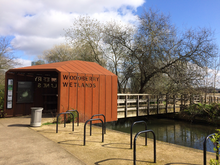
Woodberry Wetlands entrance with bridge over New River
- Great Amwell
- Hoddesdon
- Broxbourne
- Cheshunt
- Enfield
- Palmers Green
- Bowes Park
- Wood Green (passing close to Alexandra Palace)
- Hornsey
- Harringay
- Finsbury Park
Its original termination, most Clerkenwell, Islington, became known as the New River Head where the water filled a large cistern - the Circular Pond - next to the current location of Sadler's Wells theatre — where water from the river was used to flood a big tank to stage an Aquatic Theatre at the first of the nineteenth century.[ii] In 1946, the water supply to New River Caput was truncated at Stoke Newington with the New River ending at the East Reservoir.[three] The reservoir is managed as the Woodberry Wetlands – a nature reserve and designated Site of Metropolitan Importance.
Construction [edit]

Sir John Backhouse, a founding member of the New River Company. The Round Pond, the Visitor's first reservoir is seen in the movie
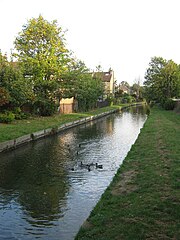
Straight section of the New River passing through Bowes Park.
The design and construction of the New River is often attributed solely to Sir Hugh Myddelton. Edmund Colthurst start proposed the thought in 1602, obtaining a charter from King James I in 1604 to carry it out. After surveying the route and digging the kickoff two miles (3 km) stretch, Colthurst encountered financial difficulties and information technology roughshod to Myddelton to complete the work between 1609 and its official opening on 29 September 1613. The project was also rescued by the Rex personally, whose house and lands at Theobalds Park were crossed by the river. James took one-half of the shares in 1612 for a half of the profits. In guild to give the project a firmer legal and financial construction, The New River Company was incorporated in 1619 by Royal Lease, with the aid of Sir John Backhouse. The company's first reservoir was congenital on his land in Islington. Myddelton gave some of the shares in the New River Company to Colthurst.
The expense and engineering challenges of the project—it relied on gravity to allow the water to flow, carefully following the contours of the terrain from Ware into London, and dropping effectually just v inches per mile (8 cm/km)—were not Myddelton's only worries. He also faced considerable opposition from landowners who feared that the New River would reduce the value of their farmland (they argued that floods or overflowing might create quagmires that could trap livestock); others were concerned at the possible disruption to road transport networks between Hertfordshire and the capital. The projection almost foundered when a few landowners flatly refused to agree to let the river beyond their land. At the time, it was proposed that a project of King James for a College in Chelsea would be funded by the proceeds of a rival project to supply water to London, and this may accept spurred the New River's opponents, possibly fifty-fifty with royal encouragement. After that project failed, Myddelton was eventually strongly supported by the king, who agreed to pay one-half the projection's expenses in return for a 50% shareholding; such backing quickly silenced the scheme's critics.
When it was originally synthetic, long sections, for example around Forty Hall and in Hornsey, wound around the heads of small tributary valleys of the Lea. Other sections of the river, including the one in Harringay, were carried beyond valleys in wooden aqueducts lined with lead and supported by stiff timbers and brick piers. In at to the lowest degree one section, locals referred to the river as the boarded river. Improvements in canal construction in the eighteenth century led to these sections being replaced by clay-banked canals.[4]
On ix January 1622 King James rode from Theobalds afterwards dinner to run across the ice on the New River and fell in caput starting time so that his companions could just see his boots. He was rescued by Sir Richard Young and returned to a warm bed at Theobalds.[5]
New River Company [edit]
The New River Company was incorporated by royal charter in 1619 with Sir Hugh Myddleton as beginning governor. Under the charter, it was a penal offence to throw rubbish or carrion into the river, while anyone washing clothes in it or planting sallow, willow or elm trees within v yards of it would incur the "Rex'south displeasure".[6]
The company became a pregnant landowner in the Clerkenwell district of Islington and laid out streets and squares which take their proper noun from people and places associated with the visitor, including Amwell Street, River Street, Mylne Street, Chadwell Street and Myddelton Square.
When London's population grew beyond a million inhabitants, the "New River" failed to give an acceptable supply of water, and other companies were formed for the purpose of supplying dissimilar parts of London: Chelsea Waterworks and others were started by various companies in succession. This company's water was oftentimes by commissions found purer than the others.[ citation needed ] It was as well, due to its source, not impacted by the ban on the supply of drinking water from the tidal Thames under the Metropolis H2o Act 1852 from ane August 1855. After this the company continued to focus on its quality.
Dr. Frankland's analysis of water supplied to London during the month of October 1876 gave a relative degree of organic impurity compared to a given volume of the Kent Company'due south h2o. He also compared the samples from those of August and September. Organic impurity was measured relative to the Kent Water Company's benchmark, who supplied part of London (in areas, in direct contest with the others). The figures were:[7]
| Competing company | Relative impurity |
|---|---|
| New River | 0.9 |
| Kent | ane |
| E London | two.4 |
| West Middlesex | 2.8 |
| Yard Junction | 3.3 |
| Lambeth | iv.one |
| Chelsea | 4.two |
| Southwark | 4.five |
The h2o delivered by the latter 5 companies, drawing their supply exclusively from the Thames, when compared with that supplied in Baronial and September, showed a marked deterioration in quality. It had a higher proportion of contamination with organic matter.[seven]
The New River Visitor was taken over by the Metropolitan Water Board in 1904 and became function of Thames Water in 1973. The northern part of the New River is nonetheless an of import link in the supply of water to London.
The company's former headquarters and laboratory at New River Head on Rosebery Avenue are now private flats; during daylight hours at that place is public access to a viewpoint over the gardens and into the adjacent garden of Nautilus Business firm. At the rear of the building (not open to the public but visible from the gardens) are the remains of the 'Chimney' or 'Devil's' Conduit, the medieval conduit-caput of the water supply of the London Greyfriars, discovered in Bloomsbury in 1911 and re-erected here in 1927.[8] [9]
Later alterations [edit]

The New River in Clissold Park, Stoke Newington. This short section of the New River was recreated as an amenity for the park after long abandonment. (September 2005)
A winding original section of the aqueduct that used to run through the town centre of Enfield has been cut off from the main flow, simply is all the same maintained equally an of import local civic amenity chosen the New River Loop.
Another large loop originally ran around the Devonshire Hill surface area in north Woods Green and southern Enfield. This loop was cut off when the Woods Greenish tunnel, which starts at Bowes Park, was completed in 1852. The loop existed for some decades, but was completely filled in and lost by the early 1900s. At present entirely covered by residential development dating mostly back to the 1930s, its one-time course is visible on numerous maps drawn in the 1800s and early 1900s.
Originally the form was above-ground throughout, but in the second half of the nineteenth century some sections were put underground, enabling the course to be straightened. In 1946 the River ceased to run above ground beyond the 1830s Eastward Reservoir near Stoke Newington, now renamed Woodberry Wetlands, into which its menstruation is now entirely diverted. The picture (right) shows a brusk recreated stretch of the River in Hackney. Across here, the River used to run along the route of Petherton Route in Highbury.
The New River Aqueduct (51°40'58.vi"N 0°03'16.0"W) was built in 1985 to bear the New River, then running on an embankment, over the London Orbital State highway (M25) which was then being constructed. The aqueduct carries the river in two parallel concrete boxes each 90 1000 long, 4.25 one thousand wide and 2 grand deep. The double box design allowed the temporary diversion of the river during structure and also enables maintenance to be undertaken on either side without stopping the flow.[10]
The route of the New River now provides a walking route through Islington. From Clissold Park, its route along the broad verge down the eye of Petherton Road leads to Essex Road, where some other redundant department of the New River's class betwixt Canonbury and Islington boondocks centre forms a path aslope the now shallow stream, recreated every bit part of a linear park. At Canonbury Road, the walk continues through a fernery to Pleasant Place, where an inscription in the pavement marks the New River'southward route. At Islington Green, there is a statue of Sir Hugh Myddelton; the route continues along Colebrooke Row and Duncan Terrace to the Angel, and then through Owen's Field to the New River Head between Amwell Street and Rosebery Artery. The New River's form between Assurance Swimming Route and Essex Road, and along Colebrooke Row up to City Route, is marked by white boulders.
The Matriarch Alice Owen's Schoolhouse bombing [edit]
On 15 October 1940, approximately 150 people were sheltering in the basement of Dame Alice Owen'southward School, and so situated on Goswell Road. A large parachute mine hit the building directly, causing the structure to collapse and blocking admission to the basement. The nail wave from the bomb caused the pipeline conveying the New River to rupture, flooding the shelter and killing the majority of the people taking cover.[xi]
A memorial to the victims of the bombing stands in Owen'south Fields at the northern end of Goswell Road.
Drownings and accidents [edit]
Charles Lamb wrote an essay about a friend he calls G. D. (probably the blind poet George Dyer) who walked into the New River by accident but was rescued. From "Amicus Redivivus" in Essays of Elia:
I do not know when I accept experienced a stranger sensation, than on seeing my erstwhile friend Yard.D., who had been paying me a morning time visit a few Sundays back, at my cottage at Islington, upon taking exit, instead of turning down the right hand path by which he had entered—with staff in paw, and at noon day, deliberately march right forwards into the midst of the stream that runs by u.s., and totally disappear. A spectacle like this at dusk would take been appalling enough; only, in the broad open daylight, to witness such an unreserved motion towards self-devastation in a valued friend, took from me all power of speculation. […]
Waters of Sir Hugh Middleton—what a spark you lot were like to have extinguished for ever! Your salubrious streams to this Urban center, for now near two centuries, would hardly take atoned for what y'all were in a moment washing abroad. Mockery of a river—liquid artifice—wretched conduit! henceforth rank with canals, and sluggish aqueducts. Was information technology for this, that, smit in adolescence with the explorations of that Abyssinian traveller, I paced the vales of Amwell to explore your tributary springs, to trace your salutary waters sparkling through green Hertfordshire, and cultured Enfield parks?—Ye have no swans—no Naiads—no river God—or did the benevolent hoary aspect of my friend tempt ye to suck him in, that ye also might take the tutelary genius of your waters?
Had he been drowned in Cam in that location would have been some consonancy in information technology; only what willows had ye to wave and rustle over his moist sepulture?—or, having no name, likewise that unmeaning assumption of eternal novity, did ye think to become ane by the noble prize, and henceforth to be termed the STREAM DYERIAN?
Rochemont Barbauld, minister of the nearby Newington Greenish Unitarian Church and hubby of Anna Laetitia Barbauld, went violently insane, attacked his wife, and committed suicide by drowning himself in the New River in 1811.
Encounter also [edit]
- Canals of the Great britain
- History of the British canal system
- Robert Mylne Principal Engineer, 1769–1810
- William Chadwell Mylne Master Engineer, 1810–1861
- London water supply infrastructure
References [edit]
- ^ Guide to the Waterways 1 London,K Marriage,Oxford&Lee Published by Nicholson& Ordnance Survey (1997) p.104 ISBN 0-7028-3296-0 Retrieved 4 January 2008
- ^ Victorian Theatres in London accessed 14 September 2009
- ^ The New River Path – a walk linking Hertford with Islington accessed 27 Oct 2011
- ^ History of Tottenham, William Robinson, 1840
- ^ John Nichols, Progresses of James the First, vol. 4 (London, 1828), pp. 750-1.
- ^ Timbs, John (1855). Curiosities of London: Exhibiting the Most Rare and Remarkable Objects of Interest in the Metropolis. D. Bogue. p. 611.
- ^ a b Edward Walford (1878). "Underground London: Its railways, subways and sewers". Old and New London: Volume 5. Institute of Historical Inquiry. Retrieved 26 June 2013.
- ^ Holder, Nick (2017). The Friaries of Medieval London: From Foundation to Dissolution. Woodbridge: Boydell. pp. 246–9. ISBN9781783272242.
- ^ "NEW RIVER HEAD CHIMNEY CONDUIT (DEVil's CONDUIT) IN THE ROUND RESERVOIR, non Civil Parish - 1208516 | Historic England".
- ^ Engineering Timelines. "New River Aqueduct, M25". Engineering Timelines . Retrieved 26 June 2020.
- ^ "Unveiling of Memorial to the Victims of the London Blitz". Dame Alice Owen's School. Retrieved xi May 2007.
Farther reading [edit]
- Camden New Journal commodity, "H2o a lot of history we have on tap" (11 December 2003)
- Chambers Volume of Days 29 September
- Ward, Robert. London's New River. London: Historical Publications, 2003. ISBN 978-0-948667-84-8 (out of impress)
- London's New River in Maps Vol. i (Function i) c.1600 to 1850 Robert Mylne's Survey (Ware to Enfield Flash), 368pp hardback by M.F. Kensey, 2012. ISBN 978-0-9572240-0-1
- London's New River in Maps Vol. one (Part 2) c.1600 to 1850 Robert Mylne'south Survey (Enfield Flash to New River Head, Islington), 368pp hardback by M.F. Kensey, 2013. ISBN 978-0-9572240-i-8
- Essex-Lopresti, Michael. Exploring the New River, 3rd Revised edition (1997) 80pp paperback ISBN 978-18585806-viii-5
- "A River Through it - Development of the New River and Water Works in Hornsey" (4 March 2020), published on Harringay Online.
External links [edit]
- The Reservoirs Nature Society (TeRNS)
- New River Action group (NRAG)
- New River walking road
Coordinates: 51°44′42″N 0°00′50″Due west / 51.7451°N 0.0138°W / 51.7451; -0.0138
Source: https://en.wikipedia.org/wiki/New_River_%28London%29
0 Response to "How to Upload a Map to Minehit"
Post a Comment