Everything You Need to Know About the Underground Railroad
 Map of Underground Railroad routes to mod mean solar day Canada | |
| Founding location | United States |
|---|---|
| Territory | United States, and routes to British Due north America, United mexican states, Spanish Florida, and the Caribbean |
| Ethnicity | African Americans and other compatriots |
| Activities |
|
| Allies |
|
| Rivals | Slave catchers, Reverse Underground Railroad |
The Hush-hush Railroad was a network of secret routes and prophylactic houses established in the United States during the early- to mid-19th century. It was used past enslaved African Americans primarily to escape into free states and Canada.[i] The network was assisted by abolitionists and others sympathetic to the cause of the escapees.[2] The enslaved who risked escape and those who aided them are also collectively referred to as the "Surreptitious Railroad".[3] Diverse other routes led to Mexico,[four] where slavery had been abolished, and to islands in the Caribbean that were not office of the slave trade.[5] An earlier escape route running due south toward Florida, then a Spanish possession (except 1763–83), existed from the late 17th century until approximately 1790.[half dozen] [7] However, the network now by and large known every bit the Underground Railroad began in the belatedly 18th century. Information technology ran due north and grew steadily until the Emancipation Proclamation was signed by President Abraham Lincoln.[eight] One judge suggests that by 1850, approximately 100,000 enslaved people had escaped via the network.[8]
Political background [edit]
For the enslaved people who "rode" the Clandestine Railroad, many of them considered Canada their final destination. An estimated 30,000 to forty,000 freedom seekers settled in Canada, half of whom came between 1850 and 1860. Others settled in complimentary states in the north.[9] Thousands of court cases for escaped enslaved were recorded between the Revolutionary War and the Ceremonious State of war.[ten] Under the original Avoiding Slave Act of 1793, officials from free states were required to assist slaveholders or their agents who recaptured fugitives, but some state legislatures prohibited this. The law made it easier for slaveholders and slave catchers to capture African Americans and return them to slavery, and in some cases allowed them to enslave free blacks. It besides created an eagerness amid abolitionists to help enslaved people, resulting in the growth of anti-slavery societies and the Underground Railroad.[xi]
With heavy lobbying by Southern politicians, the Compromise of 1850 was passed past Congress subsequently the Mexican–American War. Information technology stipulated a more stringent Avoiding Slave Law; ostensibly, the compromise addressed regional problems by compelling officials of free states to help slave catchers, granting them immunity to operate in complimentary states.[12] Considering the police required sparse documentation to claim a person was a fugitive, slave catchers also kidnapped free blacks, especially children, and sold them into slavery.[thirteen] Southern politicians often exaggerated the number of escaped slaves and often blamed these escapes on Northerners interfering with Southern belongings rights.[xiv] The law deprived people suspected of existence slaves of the right to defend themselves in courtroom, making it difficult to prove gratuitous status.[15] Some northern states enacted personal liberty laws that made it illegal for public officials to capture or imprison former slaves. [16] The perception that Northern States ignored the avoiding slave laws and regulations was a major justification for secession.[17]
Routes [edit]
Hush-hush Railroad routes went north to costless states and Canada, to the Caribbean, into United States western territories, and Indian territories. Some freedom seekers (escaped slaves) travelled South into Mexico for their freedom.[xviii]
North to free states and Canada [edit]
Structure [edit]
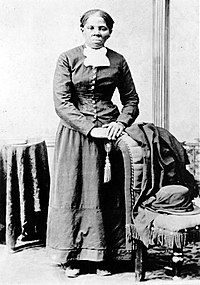
Harriet Tubman (photo H. B. Lindsley), c. 1870. A worker on the Underground Railroad, Tubman made 13 trips to the Due south, helping to free over 70 people. She led people to the Northern free states and Canada. This helped Harriet Tubman gain the name "Moses of Her People".[xix]

Quaker abolitionist Levi Coffin and his married woman Catherine helped more than 2,000 enslaved people escape to liberty.
Despite the thoroughfare's name, the escape network was neither literally surreptitious nor a railroad. (Bodily secret railroads did not exist until 1863.) According to John Rankin, "Information technology was so called considering they who took passage on it disappeared from public view as really as if they had gone into the basis. After the fugitive slaves entered a depot on that road no trace of them could be plant. They were secretly passed from one depot to some other until they arrived at a destination where they were able to remain free."[20] It was known equally a railroad, using rail terminology such equally stations and conductors, considering that was the transportation organization in use at the time.[21]
The Underground Railroad did not accept a headquarters, nor were in that location published guides, maps, pamphlets, or even paper articles. The Underground Railroad consisted of meeting points, hole-and-corner routes, transportation, and safe houses, all of them maintained past abolitionist sympathizers and communicated by word of rima oris, although in that location is also a report of a numeric code used to encrypt letters.[22] Participants generally organized in small, independent groups; this helped to maintain secrecy. People escaping enslavement would move northward along the route from one style station to the adjacent. "Conductors" on the railroad came from various backgrounds and included free-born Blacks, white abolitionists, the formerly enslaved (either escaped or manumitted), and Native Americans.[23] [24] Believing that slavery was "contrary to the ethics of Jesus", Christian congregations and clergy played a role, especially the Religious Social club of Friends (Quakers), Congregationalists, Wesleyan Methodists, and Reformed Presbyterians, as well equally the anti-slavery branches of mainstream denominations which entered into schism over the event, such as the Methodist Episcopal Church and the Baptists.[25] The role of costless Blacks was crucial; without it, there would have been almost no chance for fugitives from slavery to reach freedom safely.[26]
Routes [edit]
The Underground Railroad benefited greatly from the geography of the U.S.–Canada border: Michigan, Ohio, Pennsylvania and most of New York were separated from Canada by water, over which transport was ordinarily easy to conform and relatively safe. The master route for fugitives from the South led up the Appalachians, Harriet Tubman going via Harpers Ferry, through the highly anti-slavery Western Reserve region of northeastern Ohio to the vast shore of Lake Erie, then to Canada by boat. A smaller number, travelling by way of New York or New England, went via Syracuse (home of Samuel May) and Rochester, New York (home of Frederick Douglass), crossing the Niagara River or Lake Ontario into Canada. Those travelling via the New York Adirondacks, sometimes via the Black communities like Timbuctoo, New York, entered Canada via Ogdensburg, on the St. Lawrence River, or Lake Champlain (Joshua Young assisted). The western route, used by John Dark-brown amidst others, led from Missouri due north to free Iowa, and so east via Chicago to the Detroit River.
Terminology [edit]
Members of the Hole-and-corner Railroad often used specific terms, based on the metaphor of the railway. For example:
- People who helped enslaved people find the railroad were "agents" (or "shepherds")
- Guides were known equally "conductors"
- Hiding places were "stations" or "style stations"
- "Station masters" hid escaping slaves in their homes
- People escaping slavery were referred to as "passengers" or "cargo"
- Enslaved people would obtain a "ticket"
- Similar to common gospel lore, the "wheels would keep on turning"
- Financial benefactors of the Railroad were known equally "stockholders"[27]
The Big Dipper (whose "bowl" points to the N Star) was known equally the drinkin' gourd. The Railroad was often known as the "liberty train" or "Gospel train", which headed towards "Heaven" or "the Promised Land", i.e., Canada.[28]
William Still,[29] sometimes called "The Father of the Underground Railroad", helped hundreds of slaves escape (as many as lx a calendar month), sometimes hiding them in his Philadelphia domicile. He kept conscientious records, including short biographies of the people, that independent frequent railway metaphors. He maintained correspondence with many of them, often acting as a middleman in communications between people who had escaped slavery and those left behind. He later published these accounts in the book The Underground Railroad: Authentic Narratives and Start-Hand Accounts (1872), a valuable resource for historians to understand how the system worked and learn about private ingenuity in escapes.
Co-ordinate to Even so, messages were often encoded so that they could exist understood only past those active in the railroad. For case, the following message, "I have sent via at two o'clock iv large hams and two small hams", indicated that iv adults and two children were sent by train from Harrisburg to Philadelphia. The boosted word via indicated that the "passengers" were not sent on the usual train, but rather via Reading, Pennsylvania. In this case, the authorities were tricked into going to the regular location (station) in an attempt to intercept the runaways, while Still met them at the correct station and guided them to safety. They eventually escaped either further northward or to Canada, where slavery had been abolished during the 1830s.[30]
To reduce the take a chance of infiltration, many people associated with the Hole-and-corner Railroad knew only their office of the performance and not of the whole scheme. "Conductors" led or transported the fugitives from station to station. A usher sometimes pretended to exist enslaved to enter a plantation. Once a part of a plantation, the conductor would direct the runaways to the North. Enslaved people traveled at nighttime, about 10–xx miles (16–32 km) to each station. They rested, and so a message was sent to the next station to let the station chief know the escapees were on their way. They would stop at the so-called "stations" or "depots" during the day and rest. The stations were often located in basements,[31] barns,[32] churches,[33] or in hiding places in caves.[34]
The resting spots where the escapees could sleep and eat were given the code names "stations" and "depots", which were held by "station masters". "Stockholders" gave money or supplies for assistance. Using biblical references, fugitives referred to Canada as the "Promised Land" or "Heaven" and the Ohio River, which marked the boundary betwixt slave states and costless states, as the "River Jordan".[35]

Struggle for freedom in a Maryland befouled. Forest-engraving from William Still'south The Underground Rail Road, p. 50[36]
The majority of liberty seekers that escaped from slavery did non have help from an abolitionist. Although in that location are stories of black and white abolitionists helping liberty seekers escape from slavery many escapes were unaided.[18] Other Underground Railroad escape routes for freedom seekers were maroon communities. Maroon communities were wetlands or marshes where escaped slaves established their ain independent communities. Maroon communities in the United States were in Virginia called the Great Dismal Swamp, the maroon communities of the Black Seminole Indians in Florida, and others.[37]
Traveling atmospheric condition [edit]
Although the fugitives sometimes traveled on boat or train,[38] they usually traveled on foot or past wagon, sometimes lying downward, covered with hay or similar products, in groups of one to iii escapees. Some groups were considerably larger. Abolitionist Charles Turner Torrey and his colleagues rented horses and wagons and often transported as many equally 15 or 20 people at a time.[39] Free and enslaved black men occupied equally mariners (sailors) helped enslaved people escape from slavery by providing a ride on their ship, providing information on the safest and all-time escape routes, and safe locations on state, and locations of trusted people for assist. Enslaved African American mariners had data about slave revolts occurring in the Caribbean, and relayed this news to enslaved people they had contact with in American ports. Gratis and enslaved African-American mariners assisted Harriet Tubman in her rescue missions. Black mariners provided to her data well-nigh the best escape routes, and helped her on her rescue missions.
Routes were oft purposely indirect to confuse pursuers. Nearly escapes were by individuals or pocket-sized groups; occasionally, there were mass escapes, such as with the Pearl incident. The journeying was frequently considered particularly hard and dangerous for women or children. Children were sometimes difficult to keep serenity or were unable to continue upward with a grouping. In addition, enslaved women were rarely immune to leave the plantation, making it harder for them to escape in the same ways that men could.[40] Although escaping was harder for women, some women were successful. I of the near famous and successful conductors (people who secretly traveled into slave states to rescue those seeking liberty) was Harriet Tubman, a woman who escaped slavery.[41] [42]
Due to the risk of discovery, information about routes and prophylactic havens was passed along past word of mouth, although in 1896 in that location is a reference to a numerical code used to encrypt messages. Southern newspapers of the day were often filled with pages of notices soliciting information about fugitive slaves and offering sizable rewards for their capture and render. Federal marshals and professional compensation hunters known as slave catchers pursued fugitives as far as the Canada–US border.[43]
Fugitives were non the only black people at chance from slave catchers. With demand for slaves loftier in the Deep South as cotton was planted, stiff, good for you blacks in their prime number working and reproductive years were seen and treated as highly valuable bolt. Both one-time slaves and gratuitous blacks were sometimes kidnapped and sold into slavery, equally was Solomon Northup of Saratoga Springs, New York. "Certificates of liberty," signed, notarized statements attesting to the free status of private blacks too known as free papers, could easily exist destroyed or stolen, and so provided little protection to bearers.
Some buildings, such as the Crenshaw House in far southeastern Illinois, are known sites where free blacks were sold into slavery, known as the "Reverse Underground Railroad". Under the terms of the Avoiding Slave Act of 1850, when suspected fugitives were seized and brought to a special magistrate known as a commissioner, they had no correct to a jury trial and could not testify on their own behalf. Technically, they were guilty of no crime. The align or private slave-catcher needed only to swear an oath to acquire a writ of replevin for the return of property.
Congress was dominated by Southern congressmen considering the population of their states was bolstered by the inclusion of three-fifths of the number of slaves in population totals. They passed the Fugitive Slave Law of 1850 considering of frustration at having fugitives from slavery helped past the public and even official institutions outside the South. In some parts of the North, slave-catchers needed police protection to exercise their federal authority. Opposition to slavery did not mean that any states welcomed free Blacks. For instance, Indiana, whose area along the Ohio River was settled by Southerners, passed a constitutional amendment that barred free blacks from settling in that land. In Kansas, the movement to make Kansas a free state, with no slaves, at one bespeak planned to prevent complimentary Blacks from coming to Kansas as well.
Arrival in Canada [edit]

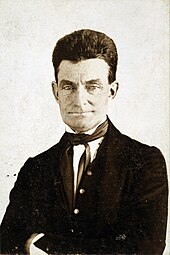
John Brown participated in the Underground Railroad as an abolitionist.
British Northward America (present-day Canada) was a desirable destination, as its long border gave many points of admission, it was farther from slave catchers, and across the reach of the United States' Avoiding Slave Acts. Further, slavery ended decades earlier in Canada than in the Usa. Britain banned the institution of slavery in present-day Canada (and in most British colonies) in 1833, though the practice of slavery in Canada had effectively ended already early in the 19th century through instance constabulary, due to court decisions resulting from litigation on behalf of slaves seeking manumission.[44]
Most erstwhile enslaved, reaching Canada by boat across Lake Erie and Lake Ontario, settled in Ontario. More than 30,000 people were said to have escaped there via the network during its 20-twelvemonth elevation period,[45] although U.South. Demography figures account for just half-dozen,000.[46] Numerous fugitives' stories are documented in the 1872 book The Underground Railroad Records by William Still, an abolitionist who and so headed the Philadelphia Vigilance Committee.[47]
Estimates vary widely, only at least thirty,000 slaves, and potentially more than 100,000, escaped to Canada via the Underground Railroad.[45] The largest grouping settled in Upper Canada (Ontario), called Canada West from 1841.[48] Numerous Blackness Canadian communities developed in Southern Ontario. These were more often than not in the triangular region bounded past Niagara Falls, Toronto, and Windsor. Several rural villages made up more often than not of people freed from slavery were established in Kent and Essex counties in Ontario.
Fort Malden, in Amherstburg, Ontario, was accounted the "main place of entry" for escaped slaves seeking to enter Canada. The abolitionist Levi Coffin, who was known for aiding over two,000 fugitives to safe, supported this option. He described Fort Malden as "the keen landing place, the principle terminus of the cloak-and-dagger railroad of the westward."[49] After 1850, approximately thirty people a twenty-four hours were crossing over to Fort Malden by steamboat.[50] : 15 The Sultana was ane of the ships, making "frequent round trips" between Great Lakes ports. Its captain, C.W. Appleby, a celebrated mariner, facilitated the conveyance of several fugitives from various Lake Erie ports to Fort Malden.[50] : 110 Other fugitives at Fort Walden had been assisted by William Wells Brownish, himself someone who had escaped slavery. He found employment on a Lake Erie steamer and transported numerous fugitives from Cleveland to Ontario by way of Buffalo or Detroit. "Information technology is well known", he tells us, "that a nifty number of fugitives brand their escape to Canada, by style of Cleaveland. ...The friends of the slave, knowing that I would transport them without charge, never failed to have a delegation when the boat arrived at Cleaveland. I have sometimes had four or five on board at one fourth dimension."[51]
Some other important destination was Nova Scotia, which was first settled by Black Loyalists during the American Revolution and and then past Black Refugees during the War of 1812 (see Black Nova Scotians). Of import Black settlements also developed in other parts of British Due north America (now parts of Canada). These included Lower Canada (nowadays-24-hour interval Quebec) and Vancouver Island, where Governor James Douglas encouraged Black immigration because of his opposition to slavery. He also hoped a significant Black community would form a barrier against those who wished to unite the island with the United States.[ citation needed ]
Upon arriving at their destinations, many fugitives were disappointed, as life in Canada was difficult. While not at chance from slave catchers due to being in a dissimilar state, discrimination was still widespread. Many of the new arrivals had to compete with mass European immigration for jobs, and overt racism was common. For instance, in reaction to Black Loyalists being settled in eastern Canada by the Crown, the metropolis of Saint John, New Brunswick, amended its lease in 1785 specifically to exclude Blacks from practicing a trade, selling goods, fishing in the harbor, or becoming freemen; these provisions stood until 1870.[52]
With the outbreak of the Ceremonious War in the U.S., many black refugees left Canada to enlist in the Wedlock Army. While some afterward returned to Canada, many remained in the Us. Thousands of others returned to the American S later on the state of war ended. The desire to reconnect with friends and family was potent, and most were hopeful about the changes emancipation and Reconstruction would bring.
Folklore [edit]
Since the 1980s, claims have arisen that quilt designs were used to signal and direct enslaved people to escape routes and help. Co-ordinate to advocates of the quilt theory, x quilt patterns were used to straight enslaved people to take particular actions. The quilts were placed one at a fourth dimension on a debate as a means of nonverbal communication to alert escaping slaves. The code had a dual meaning: first to betoken enslaved people to prepare to escape, and second to give clues and bespeak directions on the journeying.[53]
The quilt blueprint theory is disputed. The beginning published work documenting an oral history source was in 1999, and the outset publication of this theory is believed to be a 1980 children's book.[54] Quilt historians and scholars of pre-Ceremonious War (1820–1860) America have disputed this legend.[55] There is no contemporary evidence of any sort of quilt code, and quilt historians such as Pat Cummings and Barbara Brackman take raised serious questions nigh the thought. In improver, Secret Railroad historian Giles Wright has published a pamphlet debunking the quilt code.
Similarly, some popular, nonacademic sources claim that spirituals and other songs, such every bit "Steal Abroad" or "Follow the Drinking Gourd", contained coded information and helped individuals navigate the railroad. They have offered little evidence to support their claims. Scholars tend to believe that while the slave songs may certainly have expressed hope for deliverance from the sorrows of this world, these songs did non nowadays literal aid for runaway slaves.[56]
The Underground Railroad inspired cultural works. For example, "Vocal of the Free", written in 1860 near a man fleeing slavery in Tennessee by escaping to Canada, was composed to the tune of "Oh! Susanna". Every stanza ends with a reference to Canada as the state "where colored men are free". Slavery in Upper Canada (now Ontario) was outlawed in 1793; in 1819, John Robinson, the Chaser General of Upper Canada, declared that by residing in Canada, black residents were set free, and that Canadian courts would[57] protect their freedom. Slavery in Canada as a whole had been in rapid pass up later on an 1803 court ruling, and was finally abolished outright in 1834.
Legal and political [edit]
When frictions between North and Southward culminated in the Ceremonious War, many Black people, both enslaved and free, fought for the Union Regular army.[58] Post-obit Union victory in the Ceremonious State of war, on December 6, 1865, the Thirteenth Amendment to the Constitution outlawed slavery.[59] Post-obit its passage, in some cases the Hole-and-corner Railroad operated in the opposite direction, every bit fugitives returned to the Usa.[60]
Criticism [edit]
Frederick Douglass was a writer, statesman, and had escaped slavery. He wrote critically of the attention drawn to the ostensibly secret Clandestine Railroad in his seminal autobiography, Narrative of the Life of Frederick Douglass, an American Slave (1845):
I have never approved of the very public manner in which some of our western friends have conducted what they call the Hugger-mugger Railroad, but which I think, by their open declarations, has been made almost emphatically the upperground railroad.
He went on to say that, although he honors the movement, he felt that the efforts at publicity serve more to enlighten the slave-owners than the slaves, making them more watchful and making it more than hard for future slaves to escape.[61]
Notable people [edit]
- John Brown
- Owen Brown (father)
- Owen Brown (son)
- Samuel Burris
- Obadiah Bush-league
- Levi Bury
- Elizabeth Rous Comstock
- George Corson[62] [63]
- Moses Dickson[64]
- Frederick Douglass[65] [66]
- Asa Drury
- George Hussey Earle Sr.
- Calvin Fairbank
- Bartholomew Fussell
- Matilda Joslyn Gage
- Thomas Galt[67]
- Thomas Garrett[68]
- Sydney Howard Gay[69]
- Josiah Bushnell Grinnell
- Frances Harper
- Laura Smith Haviland[70]
- Lewis Hayden[71]
- John Hunn[72]
- Roger Hooker Leavitt
- Jermain Wesley Loguen[73]
- Samuel Joseph May[74]
- John Berry Meachum
- Mary Meachum[75]
- William M. Mitchell[76]
- Solomon Northup[77]
- John Parker[78]
- Mary Ellen Pleasant
- John Wesley Posey[79]
- Amy and Isaac Post
- John Rankin[eighty]
- Alexander Milton Ross
- David Ruggles[81]
- Gerrit Smith[82]
- George Luther Stearns
- William Still[83]
- John Ton
- Charles Turner Torrey[84]
- William Troy
- Harriet Tubman[85]
- Martha Bury Wright
- John Van Zandt
- Bernardhus Van Leer
- Silvia Hector Webber
S to United mexican states [edit]
Background [edit]
First in the 16th century, Spaniards brought enslaved blacks to New Spain. Over fourth dimension, free African-Spaniards took up various trades and occupations and served in the military. They had man rights.[86]

In 1806, enslaved people arrived at the Stone Fort in Nacogdoches, Texas seeking liberty. They arrived with a forged passport from a Kentuckian judge. The Spanish refused to return them back to the United States. More liberty seekers traveled through Texas the following twelvemonth.[87]
Enslaved people were emancipated by crossing the border from the United States into Mexico, which was a Spanish colony into the nineteenth century.[88] In the United States, enslaved people were considered property. That meant that they did not have rights to marry and they could be sold away from their partners. They too did not have rights to fight inhumane and vicious punishment. In New Kingdom of spain, people were recognized as humans. They were immune to bring together the Catholic Church building and marry. They besides were protected from inhumane and roughshod penalisation.[87]
During the State of war of 1812, Battle at Fort Barrancas Andrew Jackson invaded Castilian Florida in office because enslaved people had run away from plantations in the Carolinas and Georgia to Florida. Some of the runaways joined the Black Seminoles who subsequently moved to Mexico.[87] Mexico sent mixed signals, though, on their position confronting slavery. Sometimes they allowed enslaved people to returned to slavery and they allowed Americans to move into Spanish territorial holding to plant cotton plantations, bringing enslaved people to work the land.[87]
In 1829, Mexican president Vicente Guerrero (who was a mixed race black man) formally abolished slavery in Mexico.[xviii] [89] Freedom seekers from Southern plantations in the Deep Southward, specially from Louisiana, Mississippi and Texas, escaped slavery and headed for United mexican states.[xviii] [87] At that time, Texas was role of Mexico. The Texas Revolution, initiated in part to legalize slavery, resulted in the formation of the Republic of Texas in 1836.[89] Post-obit the Boxing of San Jacinto, there were some enslaved people who withdrew from the Houston surface area with the Mexican army, seeing the troops as a ways to escape slavery.[90] When Texas joined the Spousal relationship in 1845, it was a slave state[89] and the Rio Grande became the international border with Mexico.[90]
Force per unit area between costless and slave states deepened as Mexico abolished slavery in 1837 and western states joined the Spousal relationship every bit free states. As more free states were added to the Union, the bottom the influence of slave state representatives in Congress.[88] [87]
Slave states and slave hunters [edit]
The Southern Surreptitious Railroad went through slave states, lacking the abolitionist societies and the organized system of the north. People who spoke out confronting slavery were subject field to mobs, physical attack, and being hanged. In that location were slave catchers who looked for delinquent slaves. There were never more than a few hundred complimentary blacks in Texas, which meant that free blacks did non experience safe in the state. The network to freedom was breezy, random, and unsafe.[91]
Military forts, established along the Rio Grande border during the Mexican-American War of the 1840s, captured and returned fleeing enslaved people to their slaveholders.[92]
The Fugitive Slave Act of 1850 fabricated it a criminal act to aid fleeing escaping enslaved people in gratis states. Similarly, the U.s.a. authorities wanted to enact a treaty with Mexico then that they would help capture and render bonds-people. Mexico, however, connected their practice to allow anyone that crossed their borders to be gratuitous. Slave catchers continued to cantankerous the southern border into United mexican states and illegally capture black people and return them to slavery.[89] A group of slave hunters became the Texas Rangers.[92]
Routes [edit]
Routes from Indian Territory (Oklahoma), Arkansas, and Louisiana through Texas: i) Dallas or Nacogdoches to Austin - San Antonio - Laredo, 2) Nacogdoches to Houston - Galveston - boat to Mexico, 3) Nacogdoches to Houston - Matamoros[90]
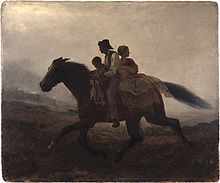
Thousands of freedom seekers traveled along a network from the southern United States to Texas and ultimately Mexico.[93] Southern enslaved people by and large traveled across "unforgiving country" on foot or horseback while pursued by lawmen and slave hunters.[91] Some stowed away on ferries bound for a Mexican port[89] [93] from New Orleans, Louisiana and Galveston, Texas.[ninety] At that place were some who transported cotton to Brownsville, Texas on wagons and then crossed into Mexico at Matamoros.[xc]
Sometimes someone would come 'long and try to get united states to run upwardly north and exist free. We used to express joy at that.
—Former slave Felix Haywood, interviewed in 1937 for the federal Slave Narrative Project.[ninety]
Many traveled through North Carolina, Arkansas, Alabama, Louisiana, or Mississippi towards Texas and ultimately Mexico.[89] [93] People fled slavery from Indian Territory (now Oklahoma).[ninety] Black Seminoles traveled on a southwestern route from Florida into Mexico.[18] [94]
Going overland meant that the last 150 miles or then were traversed through the difficult and extremely hot terrain of the Nueces Strip located between the Nueces River and the Rio Grande. There was little shade and a lack of drinkable h2o in this brush state.[91] [a] Escapees were more likely to survive the trip if they had a equus caballus and a gun.[91]
The National Park Service identified a route from Natchitoches, Louisiana to Monclova, Mexico in 2010 that is roughly the southern Underground Railroad path. It is as well believed that the El Camino Real de los Tejas was a path for freedom. It was made a National Historic Trail by President George W. Bush-league in 2004.[93]
Assistance [edit]
Some journeyed on their own without aid, and others were helped by people along the southern Underground Railroad.[89] Assistance included guidance, directions, shelter, and supplies.[91]
Blackness people, black and white couples, and anti-slavery High german immigrants provided back up, but about of the help came from Mexican laborers.[91] [93] So much so that enslavers came to distrust whatsoever Mexican, and a law was enacted in Texas that forbade Mexicans from talking to enslaved people.[90] Mexican migrant workers adult relationships with enslaved blackness workers whom they worked with. They offered guidance, such as what it would be like to cross the edge, and empathy. Having realized the ways in which Mexicans were helping enslaved people to escape, slaveholders and residents of Texan towns pushed people out of the town, whipped them in public, or lynched them.[91] [93]
Some edge officials helped enslaved people crossing into Mexico. In Monclova, Mexico a edge official took up a collection in the boondocks for a family in need of nutrient, clothing, and money to continue on their journey south and out of reach of slave hunters.[92] Once they crossed the border, some Mexican regime helped erstwhile enslaved people from being returned to the United States past slave hunters.[90]
Liberty seekers that were taken on ferries to Mexican ports were aided by Mexican ship captains, one of whom was caught in Louisiana and indicted for helping enslaved people escape.[88]
Knowing the repercussions of running away or beingness defenseless helping someone delinquent, people were conscientious to "cover their tracks" and public and personal records about freedom seekers are scarce. The are records in greater supply past the people trying to promote slavery or grab enslaved people who take run away. More than than 2,500 escapes are documented past the Texas Runaway Slave Project at Stephen F. Austin State University.[91]
Southern freedom seekers [edit]
Advertisements were placed in newspapers offering rewards for the return of their "property". Slave catchers traveled through Mexico. At that place were Black Seminoles, or Los Mascogos who lived in northern Mexico who provided armed resistance.[93]
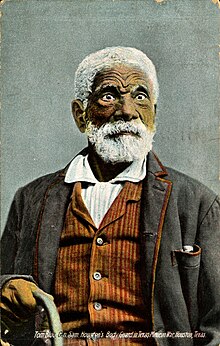
Sam Houston, president of the Republic of Texas, was the slaveholder to Tom who ran away. He headed to Texas and in one case there he enlisted in the Mexican military.[95]
Ane enslaved homo was branded with the letter of the alphabet "R" on each side of his cheek after a failed effort to escape slavery. He tried again in the wintertime of 1819, leaving the cotton plantation of his enslaver on horseback. With four others, they traveled southward west to Mexico at the take a chance of being attacked by hostile Native Americans, apprehended past slave catchers, or being attacked by "equus caballus-eating alligators".[88]
Many people did not make information technology to United mexican states. In 1842, a Mexican human being and a black woman left Jackson Canton, Texas on ii horses, only they were defenseless at the Lavaca River.[96] The wife, an enslaved woman, was valuable to her owner so she was returned to slavery. Her hubby, possibly a farm laborer or an indentured servant, was immediately lynched.[91]
Liberty seekers inverse their names in Mexico. They married into Mexican families and relocated further south of the American-Mexican border. All of these factors makes information technology hard to trace the whereabouts of the former enslaved people.[93] A database at Stephen F. Austin Land University has a database of runaway slave advertisements as part of The Texas Runaway Slave Project. The Works Progress Administration during the Great Depression initiated a Federal Writers' Projection to document slave narratives, including those who settled in United mexican states. One of them was Felix Haywood who establish freedom when he crossed the Rio Grande.[93]
Rio Grande stations [edit]
Two families, the Webbers and the Jacksons, lived along the Rio Grande and helped people escape slavery. The husbands were white and the wives were black women who had been formerly enslaved.[93] It is not known if Nathaniel Jackson purchased the freedom of Matilda Hicks and her family, merely in the early 1860s they moved to Hidalgo county, where they settled and lived as a family. He was a white southerner and she was an enslaved woman, who had been babyhood sweethearts in Alabama.[93] He was the son of her slaveholder,[89] who helped a group of vii families in 1857 and others cantankerous into United mexican states.[91]
Silvia Hector Webber was born enslaved in Westward Florida and in 1819 was sold to a slaveholder in Clark County, Arkansas. The slaveholders'south son, John Cryer, illegally brought Silvia to Mexican Texas in 1828, four years later Mexico had deemed the slave merchandise into Mexican territory confronting the police. Silvia, however, with the help of John Webber secured her and her 3 children's liberty papers in 1834.[97] Together Silvia and John lived an antislavery life and oftentimes harbored fugitives from slavery in their ranch and house. Silvia was known to send freedom seekers, on a ferry she licensed at her ranch, onto freedom in Mexico.[98]
John Ferdinand Webber, built-in in Vermont, lived along the Rio Grande with his wife, Silvia Hector Webber,[93] and together were known to have helped enslaved people cross the Rio Grande.[91] The Jacksons and Webbers, who both owned licensed ferry service, were well known among runaways.[90]
Arrival in Mexico [edit]
Freedom seekers found that when they fabricated information technology to Mexico, they lived with the knowledge that they could be illegally kidnapped by slave catchers or blackbirders.[91] Slave hunters who tried to kidnap former slaves from Mexico could be taken to courtroom or shot.[88]
At that place was little support from their new communities and few opportunities for employment. They did not accept official paperwork that stated that they were free.[91] They were, though, able to enter into indentured servitude contracts and join war machine colonies.[88]
Some people, afterward they settled in Mexico, returned to the United States to help family members escape and to guide them to Mexico.[88]
Colonies [edit]
There were abolitionists from the north who petitioned the Mexican authorities to found colonies for free and runaway blacks. Benjamin Lundy, a Quaker, lobbied for a colony to be established in what is at present Texas during the early 1830s, but he was unable to do so when Texas legalized slavery when information technology separated from Mexico and became the Republic of Texas (1836).[89] Black Seminoles successfully petitioned for land and established a colony in 1852. The country is still owned by their descendants.[89]
Scholarship [edit]
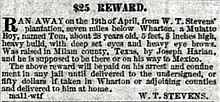
$25 Reward for Tom, Galveston Weekly News from May 11, 1858
The Texas Delinquent Slave Project, located in Nacogdoches at the Stephen F. Austin State University, has researched runaway advertisements that appeared in 19,000 editions of newspapers from the mid-19th century.[90]
Alice L. Baumgartner has studied the prevalence of enslaved people who fled slavery from the Southern slave states to Mexico. She published South to Freedom: Runaway Slaves to Mexico and the Road to the Civil State of war.[87] Thomas Mareite completed a doctoral dissertation at Leiden University on the social and political experiences of enslaved people who escaped from chains from the US South to Mexico titled Conditional liberty : free soil and avoiding slaves from the United states South to Mexico'due south Northeast, 1803-1861.[99] Roseann Bacha-Garza, of the University of Texas Rio Grande Valley, has managed historical archæology projects and has researched the incidence of enslaved people who fled to Mexico.[92] [100] Maria Esther Hammack completed her doctoral dissertation titled Due south of Slavery: Freedom Fighters & Black Movement beyond a Global Frontier, 1790-1868 on the experiences and channels undertaken by liberty seekers, at the University of Texas at Austin.[92]
Mekala Audain recently published a affiliate titled "A Scheme to Desert: The Louisiana Purchase and Freedom Seekers in the Louisiana-Texas Borderlands, 1804-1806" in the edited volume In Search of Liberty: African American Internationalism in the Nineteenth-Century Atlantic World. Audain discusses how a large number of freedom seekers had escaped Louisiana in 1804 and "did not acquaintance liberty with the northern US, the Ohio River valley, or Canada; instead they looked to the US western frontier to find freedom."[101]
National Secret Railroad Network [edit]
Following upon legislation passed in 1990 for the National Park Service to perform a special resource written report of the Undercover Railroad,[102] in 1997, the 105th Congress introduced and subsequently passed H.R. 1635 – National Underground Railroad Network to Liberty Human action of 1998, which President Bill Clinton signed into law in 1998.[103] This act authorized the Usa National Park Service to institute the National Underground Railroad Network to Freedom plan to identify associated sites, besides as preserve them and popularize the Hush-hush Railroad and stories of people involved in it. The National Park Service has designated many sites within the network, posted stories near people and places, sponsors an essay contest, and holds a national briefing about the Cloak-and-dagger Railroad in May or June each year.[104]
The Harriet Tubman Secret Railroad National Historical Park, which includes Underground Railroad routes in three counties of Maryland's Eastern Shore and Harriet Tubman'south birthplace, was created by President Barack Obama under the Antiquities Act on March 25, 2013.[105] Its sister park, the Harriet Tubman National Historical Park in Auburn, New York, was established on Jan 10, 2017, and focuses on the subsequently years of Tubman's life as well as her involvement with the Hole-and-corner Railroad and the abolition move.[106]
In popular culture [edit]
Inspirations for fiction [edit]
- The Underground Railroad is a 2016 novel past Colson Whitehead. Information technology won the 2016 National Book Award and the 2017 Pulitzer Prize for Fiction.[107]
- The Underground Railroad is a 2021 streaming television limited series, based on Whitehead's novel.
- Secret is an American television series that premiered in 2016, on WGN America.
Literature [edit]
- David Walker (1829) Appeal to the Coloured Citizens of the World
- Harriet Beecher Stowe (1852) Uncle Tom's Cabin
- Caroline Lee Hentz (1854) The Planter's Northern Helpmate
- William M. Mitchell (1860) The Nether-Ground Railroad[108]
- Sarah Hopkins Bradford (1869) Scenes in the Life of Harriet Tubman; (1896) Harriet Tubman, Moses of Her People
Music [edit]
Underground Railroad was a visitor created by Tupac Shakur, Big D the Impossible, Shock Yard, Pee Wee, Jeremy, Raw Fusion and Live Team with the purpose of promote and aid young black women and men with records allowing them to initiate and develop their musical careers.[109] [110]
Come across also [edit]
- Angola, Florida
- Ausable Chasm, NY, home of the North Star Secret Railroad Museum
- Bilger's Rocks
- Caroline Quarlls (1824–1892), first known person to escape slavery through Wisconsin's Underground Railroad
- Escape to Sweden, an "underground railroad" during the Holocaust in Norway
- Fort Mose Celebrated Land Park
- List of Undercover Railroad sites
- Reverse Underground Railroad
- Slave codes
- Tilly Escape
- Timbuctoo, New York
- Uncle Tom's Cabin Celebrated Site most Dresden, Ontario
Notes [edit]
- ^ Of contempo years, unauthorized migrants have died when crossing this expanse, evidenced past basic found by immigration agents.[90]
References [edit]
- ^ Cross, L.D. (2010). The Underground Railroad: The long journey to freedom in Canada. Toronto, ON: James Lorimer Limited, Publishers. ISBN978-1-55277-581-iii.
- ^ "Hush-hush Railroad". dictionary.com. Archived from the original on October 3, 2015. Retrieved July 17, 2011.
'A network of houses and other places abolitionists used to help enslaved Africans escape to liberty in the northern states or in Canada ... ' —American Heritage Dictionary
- ^ "The Clandestine Railroad". Public Broadcasting Service. Archived from the original on June 22, 2018. Retrieved July 25, 2007.
- ^ Leanos Jr., Reynaldo (2017). "This underground railroad took slaves to freedom in United mexican states, PRI's The World, Public Radio International, March 29, 2017". Minneapolis, MN: Public Radio International. Archived from the original on October 18, 2020. Retrieved September 4, 2019.
- ^ Leesa Jones Interview Transcript, 2020-01-07 [SHE.OH.017]. January 7, 2020.
- ^ Smith, Bruce (March xviii, 2012). "For a century, Underground Railroad ran s". Associated Press. Archived from the original on March 21, 2012. Retrieved March 23, 2012.
- ^ McIver, Stuart (February 14, 1993). "Fort Moses's Telephone call To Freedom. Florida's Little-known Cloak-and-dagger Railroad Was the Escape Route Taken by Slaves Who Fled to the Land in the 1700s and Established America's First Black Town". Sun-Sentinel. Archived from the original on Feb xiii, 2018. Retrieved Feb ten, 2018.
- ^ a b Vox, Lisa, "How Did Slaves Resist Slavery?" Archived July xi, 2011, at the Wayback Auto, African-American History, About.com, Retrieved July 17, 2011.
- ^ Henry, Natasha; McIntosh, Andrew (January 31, 2020). "Underground Railroad". The Canadian Encyclopedia . Retrieved March 2, 2022.
- ^ Schweninger, Loren (September 3, 2018). Highly-seasoned for Liberty: Liberty Suits in the S. Oxford Academy Printing. p. 9. ISBN978-0-19-066429-9.
- ^ C.Westward.A., David (January 1984). "The Fugitive Slave Police of 1793 and its Antecedents". The Journal of Negro History. The Academy of Chicago Press on behalf of the Association for the Written report of African American Life and History. ix (1): 22–25 – via JSTOR.
- ^ Potter, David, 1976 pp. 132–139
- ^ Bordewich, Fergus, 2005, p. 324
- ^ Gara, Larry. Underground Railroad. National Park Service. p. 8.
- ^ Douglass, Frederick (July 5, 1852), "The Meaning of July Fourth for the Negro" Archived July four, 2008, at the Wayback Auto, History Is a Weapon, Retrieved July 17, 2011.
- ^ Potter, David, 1976, p. 139
- ^ "Avalon Project – Amalgamated States of America – Proclamation of the Immediate Causes Which Induce and Justify the Secession of South Carolina from the Federal Union". Avalon.law.yale.edu. Archived from the original on Feb twenty, 2019. Retrieved June 7, 2016.
- ^ a b c d e Hudson, J. Blaine (2015). Encyclopedia of the Underground Railroad. McFarland, Incorporated, Publishers. p. 147. ISBN9781476602301.
- ^ Larson, p. xvii.
- ^ Ritchie, Andrew (1870). The soldier, the battle, and the victory : beingness a brief account of the work of Rev. John Rankin in the anti-slavery crusade. Cincinnati: Western Tract and Volume Lodge. pp. 96–97.
- ^ Blight, David, 2004, p. iii.
- ^ Wright, Mary Eastward. (June 21, 1896). "The Grave of Old John Brown'southward Son.—It Lies Above the San Gabriel Valley and Overlooks Pasadena.—Owen and Jason Dark-brown Lived in the Mountains and Were Guides to Tourists.—Uncle James Townsend, a Venerable Quaker, Knew Them Both Well and Their Father". San Francisco Telephone call. p. 24 – via newspapers.com.
- ^ Society, National Geographic (November sixteen, 2011). "The Underground Railroad". National Geographic Society. Archived from the original on August one, 2017. Retrieved August 1, 2017.
- ^ Miles, Tiya (Summer 2011). "Of Waterways and Runaways: Reflections on the Great Lakes in Hole-and-corner Railroad History". Michigan Quarterly Review. Vol. L, no. 3. hdl:2027/spo.act2080.0050.320. ISSN 1558-7266.
- ^ History of Salem Township, Washtenaw County, Michigan. Salem Expanse Historical Society. 1976. p. 56.
- ^ Pinsker, Matthew (2000). Vigilance in Pennsylvania: Underground Railroad Activities in the Keystone Land, 1837–1861. Lancaster: PHMC.
- ^ Blight, David, 2004, p. 98
- ^ "History – National Underground Railroad Freedom Centre". Freedomcenter.org. Archived from the original on August 17, 2018. Retrieved June 7, 2016.
- ^ Blight, David, 2004, p. 175
- ^ Still, William (1872). The Cloak-and-dagger Railroad: Authentic Narratives and First-Hand Accounts. ASIN B00264GNTU. Archived from the original on December 14, 2018. Retrieved July 25, 2015.
- ^ Cedarville University (Feb 12, 2018). "Underground Railroad Hiding Places". Slideshow Images.
- ^ "Point of interest at Oakland City—site of befouled of Col. James Westward. Cockrum used as an undercover railroad station". Wabash Valley Visions & Voices Digital Retentivity Projection. 1930s. Archived from the original on Apr xv, 2021. Retrieved February 27, 2021.
- ^ "The Secret Railroad". National Museum of African American History and Civilisation. March 15, 2017. Archived from the original on March 10, 2021. Retrieved February 28, 2021.
- ^ "The Smith Underground Railroad Station :: Ohio :: Henry Robert Burke :: Lest We Forget". lestweforget.hamptonu.edu. Archived from the original on April 15, 2021. Retrieved February 28, 2021.
- ^ "Hush-hush Railroad Codes" (PDF). Myths and Codes of the Underground Railroad. Prophylactic Passage. Greater Cincinnati Tv Educational Foundation. p. xx. Archived (PDF) from the original on June 12, 2018. Retrieved June 29, 2013.
- ^ Dictated by Robert Jackson a.k.a. Wesley Harris on November 2, 1853. "Engravings by Bensell, Schell, and others."
- ^ Hudson (January 9, 2015). Encyclopedia of the Underground Railroad. McFarland. pp. 143–144. ISBN9781476602301.
- ^ Bordewich, Fergus, 2005, p. 236
- ^ Torrey, E. Fuller (2013). The Martyrdom of Abolitionist Charles Torrey. Baton Rouge: Louisiana State University Press.
- ^ Blackett, Richard (October 2014). "The Underground Railroad and the Struggle Against Slavery". History Workshop Periodical. 78 (one): 279. doi:10.1093/hwj/dbu012. S2CID 154049844.
- ^ Wellington, Darryl Lorenzo (January twenty, 2004). "The nigh famous abductor on the Underground Railroad". Christian Science Monitor. Archived from the original on September 7, 2018. Retrieved January 9, 2012.
- ^ "Clandestine Railroad - Black History - HISTORY.com". HISTORY.com. Archived from the original on December 15, 2018. Retrieved August i, 2017.
- ^ Potter, David, 1976, p. 133.
- ^ Mary Ann Shadd (2016). A Plea for Emigration; or Notes of Canada Due west: A Broadview Album of British Literature Edition. Broadview Press. p. 11. ISBN978-i-55481-321-half dozen. Archived from the original on April 15, 2021. Retrieved November 30, 2020.
- ^ a b "Settling Canada Underground Railroad". Historica Minutes. Archived from the original on January half dozen, 2010. Retrieved January 30, 2018.
Between 1840 and 1860, more than 30,000 people enslaved in America came secretly to Canada and freedom
- ^ "From slavery to freedom" Archived July thirteen, 2007, at the Wayback Automobile, The Grapevine, pp. 3–5.
- ^ Jr, Deborah Gray White, Mia Bay, Waldo Eastward. Martin (2013). Freedom on My Mind: A History of African Americans, with documents. Boston: Bedford/St. Martin'southward. p. 287. ISBN978-0-312-64883-ane.
- ^ Bordewich, Fergus, 2005, p. 379
- ^ Landon, Fred (1925). "Amherstburg, Terminus of the Hugger-mugger Railroad". Journal of Negro History. ten (i): v. doi:10.2307/2713665. JSTOR 2713665. S2CID 149997017.
- ^ a b Tom Calarco, Places of the Underground Railroad: A Geographical Guide (Santa Barbara, CA: ABC-CLIO, LLC, 2011)
- ^ Brown, William Westward. (1848). Narrative of William W. Brown, a fugitive slave. The Anti-slavery Office (second ed.). Boston. pp. 107–108.
- ^ "Arrival of the Black Loyalists: Saint John'due south Black Community" Archived May 19, 2011, at the Wayback Machine, Heritage Resources Saint John
- ^ Williams, Ozella McDaniels, 1999.
- ^ Aronson, Marc (Apr 1, 2007). "History That Never Happened". Schoolhouse Library Journal. Archived from the original on November 9, 2012. Retrieved March 31, 2011.
- ^ Stukin, Stacie (April 3, 2007). "Unravelling the Myth of Quilts and the Hush-hush Railroad". Time. Archived from the original on January 13, 2017. Retrieved January 18, 2017.
- ^ Kelley, James (April 2008). "Vocal, Story, or History: Resisting Claims of a Coded Bulletin in the African American Spiritual 'Follow the Drinking Gourd'". The Journal of Popular Culture. 41 (2): 262–280. doi:ten.1111/j.1540-5931.2008.00502.10.
- ^ "Black History-From Slavery to Settlement". Athenaeum.gov.on.ca. Archived from the original on Feb 14, 2013. Retrieved June vii, 2016.
- ^ Marker Lardas, African American Soldier in the Civil War: USCT, 1862–66
- ^ Ann Heinrichs, The Underground Railroad
- ^ Gindy, Gaye East. (2008). The Underground Railroad and Sylvania'southward Historic Lathrop Firm. p. 20. ISBN9781434367617. Archived from the original on March 5, 2016. Retrieved July 25, 2015.
- ^ Douglass, Frederick. (1845) Narrative of the Life of Frederick Douglass. Dover Publications. Chapter xi.
- ^ William Still, "George Corson," The Undercover Rail Road, (Philadelphia: Porter & Coates, 1872), pp. 721–23.
- ^ "Letters: Underground Railroad site threatened in Montco". Manufactures.philly.com. Archived from the original on May 31, 2016. Retrieved June 7, 2016.
- ^ Kwame Anthony Appiah and Henry Louis Gates Jr, Africana: The Encyclopedia of the African and African American Experience, Oxford Academy Press, 1999 ISBN 978-0195170559
- ^ "Aboard the Underground Railroad" – Boston African American NHS Archived June 14, 2019, at the Wayback Motorcar. Nps.gov (September 5, 1962). Retrieved on August sixteen, 2013.
- ^ "The Rochester Years". Archived from the original on Nov 24, 2011. Retrieved December 3, 2011.
- ^ "For the People: A Newsletter of the Abraham Lincoln Association v.eight number 1 Spring 2006, Springfield, Illinois" (PDF). Archived from the original (PDF) on Oct 8, 2007. Retrieved October 25, 2007.
- ^ Foner pp. 155–159.
- ^ Foner pp. nine–x.
- ^ Carlarco pg. 144–152.
- ^ Calarco p. 153.
- ^ Foner p. 156.
- ^ Foner p. 180.
- ^ Foner pp. 146–147.
- ^ "Mary Meachum and the Underground Railroad". St. Louis Public Radio. October nine, 2012. Archived from the original on March 5, 2016. Retrieved Nov 1, 2015.
- ^ Calarco pp. 210–211.
- ^ Calarco pp. 222–224.
- ^ Calarco pp. 225–228.
- ^ Calarco pp. 236–238.
- ^ Calarco pp. 242–250.
- ^ Foner pp. ii–three.
- ^ Foner pp. 58–59 123–124.
- ^ Foner p. thirteen.
- ^ Foner pp. 87–88.
- ^ Foner pp. 190–94.
- ^ "African American Texans" (PDF). Institute of Texan Cultures, University of Texas at San Antonio (UTSA). 2019.
- ^ a b c d eastward f thousand Barnes, Michael (April 13, 2021). "I road of the Underground Railroad ran through Texas to Mexico". Austin American-Statesman . Retrieved July 7, 2021.
- ^ a b c d e f g Crable, Margaret (February 1, 2021). "USC Dornsife historian uncovers the Underground Railroad that ran to Mexico > News > USC Dornsife". Dornsife, University of Southern California . Retrieved July 5, 2021.
- ^ a b c d due east f yard h i j Little, Becky. "The Little-Known Undercover Railroad That Ran S to Mexico". HISTORY . Retrieved July three, 2021.
- ^ a b c d e f g h i j k fifty Burnett, John (February 28, 2021). "A Affiliate In U.S. History Often Ignored: The Flight Of Runaway Slaves To Mexico". Georgia Public Broadcasting . Retrieved July 8, 2021. (heard on All Things Considered)
- ^ a b c d eastward f g h i j k 50 grand Bird, Tyson (Jan 28, 2021). "The Little Known History of Texas' Underground Railroad". Texas Highways . Retrieved July 5, 2021.
- ^ a b c d e Leanos, Reynaldo Jr. (March 29, 2017). "This underground railroad took slaves to freedom in Mexico". The World, a public radio program . Retrieved July 7, 2021.
- ^ a b c d e f chiliad h i j yard fifty Contreras, Russell (September 17, 2020). "Story of the Underground Railroad to Mexico gains attending". Lookout Colorado . Retrieved July 3, 2021.
- ^ "What is the Underground Railroad?". The National Park Service.
- ^ Piffling, Becky (October 25, 2018). "Forgotten History: Mexico accepted slave migrants fleeing the U.S." Vallarta Daily News . Retrieved July viii, 2021.
- ^ Hammack, María (June 5, 2019). "Dear In Times of Texas Slavery". Not Even Past. The Department of History, The University of Texas at Austin. Retrieved Baronial 13, 2021.
- ^ Hammack, María Esther (Spring 2020). "Silvia Hector Webber". Texas State Historical Clan . Retrieved Baronial xiii, 2021.
- ^ Hammack, Maria (January 31, 2021). "Silvia Hector Webber". mariaesteherhammack.me. Maria Hammack. Retrieved August 13, 2021.
- ^ Mareite, Thomas, Conditional Liberty: Free Soil and Avoiding Slaves from the US Southward to United mexican states'southward Northeast, 1803-1861 (PhD Diss., Leiden University, 2020) https://scholarlypublications.universiteitleiden.nl/handle/1887/85166
- ^ Contreras, Russell, Associate Press (September sixteen, 2020). "Story of the Underground Railroad to Mexico gains attention". The Washington Mail service. ISSN 0190-8286. Retrieved July 7, 2021.
- ^ Johnson, Angelo (2021). In Search of Liberty: African American Internationalism in the Nineteenth-Century Atlantic Earth. Athens: Academy of Georgia Press.
- ^ "The Underground Railroad Leaves its Tracks in History". Government Volume Talk. Feb 27, 2012. Archived from the original on May 15, 2020. Retrieved June ten, 2020.
- ^ Stokes, Louis (July 21, 1998). "Actions – H.R.1635 – 105th Congress (1997–1998): National Underground Railroad Network to Liberty Act of 1998". www.congress.gov. Archived from the original on June 10, 2020. Retrieved June 10, 2020.
- ^ "Network to Freedom Homepage". www.nps.gov. Archived from the original on December 3, 2018. Retrieved Jan sixteen, 2017.
- ^ "Direction – Harriet Tubman Undercover Railroad National Historical Park (U.S. National Park Service)". www.nps.gov. Archived from the original on June ten, 2020. Retrieved June 10, 2020.
- ^ "Harriet Tubman National Historical Park (U.S. National Park Service)". world wide web.nps.gov. Archived from the original on June 10, 2020. Retrieved June 10, 2020.
- ^ "The 2017 Pulitzer Prize Winner in Fiction". pulitzer.org. Archived from the original on April xi, 2017. Retrieved April 10, 2017.
- ^ Mitchell, William (1860). . W. Tweedie – via Wikisource. [ scan
 ]
] - ^ "2Pac Total UNSEEN Interview (1992) Speaks on Police Brutality". YouTube.
- ^ "2Pacalypse Now 1991 Biography, Part 2". December nineteen, 2016.
- Blight, David W. (2004). Passages to Freedom: The Hugger-mugger Railroad in History and Retentivity . Smithsonian Books. ISBN1-58834-157-seven.
- Bordewich, Fergus 1000. (2005). Spring for Canaan: The Underground Railroad and the State of war for the Soul of America. Harper Collins. ISBN0-06-052430-viii.
- Calarco, Tom (2008). People of the Underground Railroad: A Biographical Dictionary. Westport, Connecticut: Greenwood Press. ISBN978-0313339240. Archived from the original on July 29, 2020. Retrieved June 23, 2020.
- Chadwick, Bruce (2000). Traveling the Underground Railroad: A Visitor'southward Guide to More than 300 Sites. Citadel Press. ISBN0-8065-2093-0.
- Frost, Karolyn Smardz; Osei, Kwasi (2007). I've Got a Home in Glory State: A Lost Tale of the Underground Railroad . Farrar, Straus & Giroux. ISBN978-0-374-16481-2.
- Foner, Eric (2015). Gateway To Freedom: The Hidden History of the Underground Railroad. New York, New York: Norton. ISBN 0393244075
- Forbes, Ella (1998) But Nosotros Have No Land: The 1851 Christiana Pennsylvania Resistance. Africana Homestead Legacy Publishers.
- Griffler, Keith P. (2004). Front Line of Liberty: African Americans and the Forging of the Underground Railroad in the Ohio Valley. University Press of Kentucky. ISBN0-8131-2298-8. Archived from the original on July 9, 2020. Retrieved November twenty, 2015.
- Hagedorn, Ann (2004). Beyond the River: The Untold Story of the Heroes of the Clandestine Railroad. Simon & Schuster. ISBN0-684-87066-5.
- Hendrick, George; Willene Hendrick (2010), Black refugees in Canada: accounts of escape during the era of slavery, McFarland & Co, ISBN9780786447336, archived from the original on July 9, 2020, retrieved Nov 20, 2015
- Hendrick, George; Hendrick, Willene (2003). Fleeing for Freedom: Stories of the Underground Railroad Equally Told by Levi Coffin and William Yet . Ivan R. Dee Publisher. ISBNone-56663-546-2.
- Hudson, J. Blaine (2002). Fugitive Slaves and the Underground Railroad in the Kentucky Borderland . McFarland & Visitor. ISBN0-7864-1345-X.
- LaRoche, Cheryl Janifer (2014). Free Black Communities and the Underground Railroad: The Geography of Resistance. Urbana, Illinois: Academy of Illinois Press.
- Potter, David M. (1976). The Impending Crunch, 1848–1861 . ISBN0-06-131929-5.
- "Operating the Hugger-mugger Railroad". National Park Service. Archived from the original on Dec 26, 2016. Retrieved January 29, 2007.
- "Role 4: 1831–1865 Narrative, The Underground Railroad". Africans in America c.1780 – 1862: Judgment 24-hour interval. PBS. Archived from the original on June 22, 2018. Retrieved September 17, 2017.
Further reading [edit]
- Colson Whitehead (2016). The Underground Railroad; winner of the Pulitzer Prize in 2017 for this poetical, mythical reflection on the meaning of the Railroad in American history.
- Blackett, R.J.K. (2013). Making Liberty: The Underground Railroad and the Politics of Slavery. Chapel Hill, NC: University of North Carolina Press.
- Curtis, Anna Fifty. (1941). Stories of the Underground Railroad. Archived from the original on March 31, 2012. (Stories about Thomas Garrett, a famous amanuensis on the Underground Railroad)
- Frost, Karolyn Smardz (2007). I've Got a Abode in Glory Country: A Lost Tale of the Secret Railroad . New York: Farrar, Straus and Giroux. ISBN9780374531256.
- Larson, Kate Clifford (2004). Leap For the Promised Land: Harriet Tubman, Portrait of an American Hero. New York: Ballantine Books. ISBN0-345-45627-0.
- Still, William (1872). The Underground Railroad: A Record of Facts, Authentic Narratives, Letters, &c., Narrating the Hardships, Hair-Breadth Escapes and Decease Struggles of the Slaves in Their Efforts for Liberty, As Related by Themselves and Others, or Witnessed past the Author. Philadelphia: Porter & Coates. (Classic book documenting the Underground Railroad operations in Philadelphia).
- Public domain ebook at Projection Gutenberg
- Book at Net Archive
-
 The Secret Railroad public domain audiobook at LibriVox
- Strother, Horatio (1962; reissued 2011). The Underground Railroad in Connecticut. Wesleyan University Press. ISBN 9780819560124.
- Tilley Turner, Glennette (2001). The Surreptitious Railroad in Illinois. Newman Educational Pub. ISBN 978-0938990055.
- Jones, Leesa Bailey (January 7, 2020). "Leesa Jones Interview". Country Archives of North Carolina (Oral History). Interviewed by Ellen Brooks. Washington, N.C.
Folklore and myth [edit]
- "Documentary Prove is Missing on Underground Railroad Quilts". historyofquilts.com. Archived from the original on May fourteen, 2011. Retrieved December fifteen, 2004.
- "New Bailiwick of jersey's Underground Railroad Myth-Buster: Giles Wright is on a Mission to Fine Tune Blackness History". Historic Camden County.
- "Putting it in Perspective: The Symbolism of Underground Railroad quilts". quilthistory.com. Archived from the original on Feb four, 2013. Retrieved December xv, 2004.
- "Secret Railroad Quilts & Abolitionist Fairs". Womenfolk.com.
External links [edit]
- Secret Railroad Studies
- Secret Railroad Timeline
- Friends of the Cloak-and-dagger Railroad
- National Undercover Railroad Freedom Eye
- Underground Railroad Research Plant at Georgetown College
- Underground Railroad in Buffalo and Upstate New York: A bibliography past The Buffalo History Museum
- Newspaper manufactures and clippings about the Hugger-mugger Railroad at Newspapers.com
Source: https://en.wikipedia.org/wiki/Underground_Railroad
0 Response to "Everything You Need to Know About the Underground Railroad"
Post a Comment